

Real Clear Energy: President Trump’s Ratepayer Protection Pledge Shows How America Can Win the AI Race
President Trump's Ratepayer Protection Pledge provides an important roadmap. It recognizes that America's economic and technological leadership depends on building the infrastructure needed to power the AI era. But it also recognizes that customers deserve protection.
The good news is that we do not have to choose one goal over the other. States across the Southeast are demonstrating that America can attract data centers, strengthen communities, protect customers, and compete in the AI race at the same time.
That is a model worth scaling nationwide.
Read more here.
In a column for Real Clear Energy, PFT president Brad Viator writes, “America needs the infrastructure to lead the world in artificial intelligence. But Americans are right to ask whether they will be left paying for the massive buildout required to power that growth.
They shouldn't.
The companies driving unprecedented demand for electricity should bear the costs of serving that demand—not families and small businesses already working hard to make ends meet.
That is why the Ratepayer Protection Pledge matters. It recognizes that America does not have to choose between winning the AI race and protecting customers from higher electric bills. We can—and must—do both.
Encouragingly, some states are already showing how.”
Read the full column here.

President Trump’s Ratepayer Protection Pledge Shows How America Can Win the AI Race Without Sticking Customers with the Bill
President Donald J. Trump brought together electric utilities and state leaders to sign the Ratepayer Protection Pledge, an important step toward addressing one of the biggest challenges facing the country.
The Ratepayer Protection Pledge recognizes that America does not have to choose between winning the AI race and protecting customers from higher electric bills. We can—and must—do both. Encouragingly, states across the Southeast are already showing how. There, utilities, regulators, and policymakers are demonstrating that data center growth, customer protection, and economic development can go hand in hand.
President Donald J. Trump brought together electric utilities and state leaders to sign the Ratepayer Protection Pledge, an important step toward addressing one of the biggest challenges facing the country.
The Ratepayer Protection Pledge recognizes that America does not have to choose between winning the AI race and protecting customers from higher electric bills. We can—and must—do both. Encouragingly, states across the Southeast are already showing how. There, utilities, regulators, and policymakers are demonstrating that data center growth, customer protection, and economic development can go hand in hand.
For example:
In Georgia, fast-paced data center growth led Georgia Power to announce a Customer Protection Plan designed to ensure data centers pay more so residential customers can pay less – most recently with the utility’s landmark flexible data center deal with OpenAI, which will be integrated in a way that supports grid reliability. The company also announced a residential rate reduction of roughly $50 per year.
In North Carolina, Duke Energy has said a new Amazon Web Services data center will create 2,000 temporary jobs and 500 permanent positions. Furthermore, for each gigawatt of data center capacity signed under a 15-year contract, the company says it generates up to $1 billion in savings for the broader customer base.
And in Louisiana, Entergy has said Meta's new data center will deliver billions of dollars in customer benefits over time while helping support investments in reliability and resilience.”
Read the White House announcement here.

Pine Bluff Commercial: Data Centers can lower electricity costs in Arkansas
In a Arkansas Pine Bluff Commercial column, PFT president Brad Viator highlights Arkansas as a model for how states can support AI-driven economic growth while protecting electricity customers.
“The historic economic growth happening in Arkansas shows that when lawmakers and utilities take a thoughtful approach to integrating large customers into public electric grids, new industry like data centers can lower — instead of raise — power bills and boost the reliability of the electric grid. This approach is not only benefiting Arkansas residents today it is also establishing a model that other utilities across the country can follow. “
In a Pine Bluff Commercial column, PFT president Brad Viator highlights Arkansas as a model for how states can support AI-driven economic growth while protecting electricity customers.
“The historic economic growth happening in Arkansas shows that when lawmakers and utilities take a thoughtful approach to integrating large customers into public electric grids, new industry like data centers can lower — instead of raise — power bills and boost the reliability of the electric grid. This approach is not only benefiting Arkansas residents today it is also establishing a model that other utilities across the country can follow. “
Power for Tomorrow Statement on FERC’s Show Cause Orders
Power for Tomorrow President Brad Viator commends FERC on the steps it took today: “FERC acted wisely and soundly to focus on addressing what’s broken in the markets. FERC’s process puts every market on the hook to show that it can integrate data centers and other large loads swiftly, reliably, and with protections for other customers. Some markets are doing better than others. And the differences between them are worth FERC scrutiny. PFT looks forward to engaging as these show cause proceedings advance.”
Power for Tomorrow applauds FERC for today’s thoughtful and well-calibrated response to the growing challenge of integrating large load customers — primarily data centers — into electricity markets without compromising grid reliability or further impacting existing customers.
FERC made clear that a sweeping, one-size-fits-all response to the DOE-requested ANOPR wouldn't make sense. Instead, it opened individual show cause orders for each of the six markets under its jurisdiction. These markets are not similarly situated and addressing them together in a single docket would obscure more than it reveals.
As a next step, FERC directed each market to produce a report on resource adequacy within 30 days — a telling and compelling place to start, given that not all markets are on equal footing. In particular, this will place PJM in the spotlight, having come up 6.6 GW short in its last capacity auction. Then, within 60 days, each market must respond to its individual show cause order.
Power for Tomorrow President Brad Viator commends FERC on the steps it took today: “FERC acted wisely and soundly to focus on addressing what’s broken in the markets. FERC’s process puts every market on the hook to show that it can integrate data centers and other large loads swiftly, reliably, and with protections for other customers. Some markets are doing better than others. And the differences between them are worth FERC scrutiny. PFT looks forward to engaging as these show cause proceedings advance.”
The Roanoke Times: Commentary: Google's data center campus in Botetourt County is being done right
As data centers drive surging energy demand, the real question isn't whether data centers are good or bad — it's whether they're planned responsibly. In his latest op-ed, PFT's Brad Viator points to Google's proposed campus in Botetourt County, VA, as a model: industrial siting, significant local tax revenue, new infrastructure paid for by Google at no cost to existing customers, and genuine community collaboration. There is a way to have growth and protect customers. Smart development, not stopped development, is the answer.
As data centers drive surging energy demand, the real question isn't whether data centers are good or bad — it's whether they're planned responsibly. In his latest op-ed, PFT's Brad Viator points to Google's proposed campus in Botetourt County, VA, as a model: industrial siting, significant local tax revenue, new infrastructure paid for by Google at no cost to existing customers, and genuine community collaboration. There is a way to have growth and protect customers. Smart development, not stopped development, is the answer.
Utility Dive: PJM’s crisis has a simple solution: Copy what works in regulated states
The competitive market was supposed to produce lower prices, but when faced with the first big demand shock in decades, it delivered chaos, writes Power for Tomorrow President Brad Viator.
Read the full column in Utility Dive.
The competitive market was supposed to produce lower prices, but when faced with the first big demand shock in decades, it delivered chaos, writes Power for Tomorrow President Brad Viator.
Read the full column in Utility Dive.

PFT Urges a "No" Vote on West Virginia Senate Bill 420
In a letter sent to West Virginia legislators, Power for Tomorrow President Brad Viator calls on elected officials “to protect West Virginians from energy policy that undermines both grid reliability and customer affordability.”
“Passing SB 420 is antithetical to the Legislature’s own stated commitment to affordability. West Virginia already carries the fourth highest poverty rate in the nation. Its residents cannot afford for this legislation to move forward. If running coal plants at 69% capacity made financial sense, utilities would already be doing it, no mandate required. We urge you to vote no on SB 420 and protect the interests of West Virginians.“
In a letter sent to West Virginia legislators, Power for Tomorrow President Brad Viator calls on elected officials “to protect West Virginians from energy policy that undermines both grid reliability and customer affordability.”
“Passing SB 420 is antithetical to the Legislature’s own stated commitment to affordability. West Virginia already carries the fourth highest poverty rate in the nation. Its residents cannot afford for this legislation to move forward. If running coal plants at 69% capacity made financial sense, utilities would already be doing it, no mandate required. We urge you to vote no on SB 420 and protect the interests of West Virginians.“
PFT's Brad Viator Testifies in Support of HB 1561
Maryland’s electricity demand is rising and the grid is struggling to keep up.
Power for Tomorrow President Brad Viator testified before the Maryland House Environment and Transportation Committee in support of HB 1561, the Affordable Energy Act.
Maryland’s electricity demand is rising and the grid is struggling to keep up.
Today, Power for Tomorrow President Brad Viator testified before the Maryland House Environment and Transportation Committee in support of HB 1561, the Affordable Energy Act.
The challenge is clear:
• Electricity demand is surging due to data centers, EVs, and electrification
• PJM’s most recent capacity auction hit record prices
• And the grid still fell 6.6 gigawatts short of reliability needs, roughly equal to Maryland’s entire residential demand
HB 1561 offers a practical solution by allowing regulated utilities to build and own clean and renewable generation, strengthening reliability while helping protect customers from rising electricity costs.
States like Virginia, which also participate in PJM but allow utility-owned generation, have shown this model can work. Maintaining strong reliability while keeping electricity prices significantly lower.
Power for Tomorrow supports HB 1561 as a pragmatic step to ensure Maryland can meet growing energy demand while protecting consumers.
Read Viator’s full testimony here.
Watch a clip of the testimony here.

Power for Tomorrow Announces Leadership Changes Amid Rapidly Evolving Energy Landscape
Power for Tomorrow announced a series of leadership appointments that support the organization’s next phase amid a rapidly changing U.S. energy landscape, marked by soaring electricity demand and projected continued growth driven by data centers, electrification, and new domestic manufacturing.
Brad Viator has been elected President of Power for Tomorrow, effective immediately. In addition, Alison Williams has been appointed Senior Vice President, Public Policy & Regulatory Affairs, and Gary Meltz has been appointed Senior Vice President, Communications.
Power for Tomorrow announced a series of leadership appointments that support the organization’s next phase amid a rapidly changing U.S. energy landscape, marked by soaring electricity demand and projected continued growth driven by data centers, electrification, and new domestic manufacturing.
Brad Viator has been elected President of Power for Tomorrow, effective immediately. In addition, Alison Williams has been appointed Senior Vice President, Public Policy & Regulatory Affairs, and Gary Meltz has been appointed Senior Vice President, Communications.
Together, the new leadership team brings decades of experience across utility regulation, public policy, and strategic communications at a moment when electricity customers face increasing pressure from surging demand, infrastructure constraints, and complex regulatory debates.
“The energy sector is facing generational challenges that call for steady, strategic leadership,” said Keith Windle, Chair of the Board of Power for Tomorrow. “Brad Viator brings deep experience that will strengthen Power for Tomorrow’s work as we advocate for customers and fair pricing in an increasingly complex regulatory environment – one where reliability, affordability, and long-term planning have never been more critical.”
As president, Viator will lead Power for Tomorrow’s efforts to advocate for policies that protect customers through the regulated utility model, ensuring reliable service and fair rates as the power sector adapts to unprecedented demand growth.
“I’m honored to take on this role at such a critical time for electricity consumers across the country,” Viator said. “Power for Tomorrow’s mission – advocating for a regulated utility framework that delivers affordable, reliable service – has never been more important. As electricity demand continues to accelerate, we must ensure policies keep customers atthe center of decision-making. I’m grateful to the Board for its confidence and look forward to working with our members and partners to advance solutions that put customers first.”
Williams will lead Power for Tomorrow’s public policy and regulatory strategy, focusing on federal and state issues that affect electricity pricing, grid reliability, and investment. Meltz will oversee communications, strengthening the organization’s voice with policymakers, media, and stakeholders nationwide.
These leadership changes underscore Power for Tomorrow’s commitment to guiding the organization through a period of rapid change in the electricity sector while ensuring customers benefit from reliable service, reasonable costs, and thoughtful regulation.

RTO Insider: Where are Utilities Best Serving Customers?
As PJM grapples with reliability, load growth, and market failures, policymakers are still debating what might work next. Meanwhile, one model has already been delivering real results for more than a century.
Alison Williams of Power for Tomorrow makes the case that well-regulated, vertically integrated utilities are doing exactly what today’s power system needs.
As PJM grapples with reliability, load growth, and market failures, policymakers are still debating what might work next. Meanwhile, one model has already been delivering real results for more than a century.
Alison Williams of Power for Tomorrow makes the case that well-regulated, vertically integrated utilities are doing exactly what today’s power system needs:
Shielding customers from price spikes
Supporting economic growth and industrial competitiveness
Delivering reliability through long-term planning and accountability
The data are hard to ignore: residential customers in deregulated states paid 42% more for electricity than those served by vertically integrated utilities, and the gap is growing.
At a moment when energy policy conversations are accelerating fast, this article asks a simple question policymakers should keep front and center:
What actually works for customers?
Read the full article here.
PJM’s Plan Confirms the Problem Markets Alone Can’t Solve
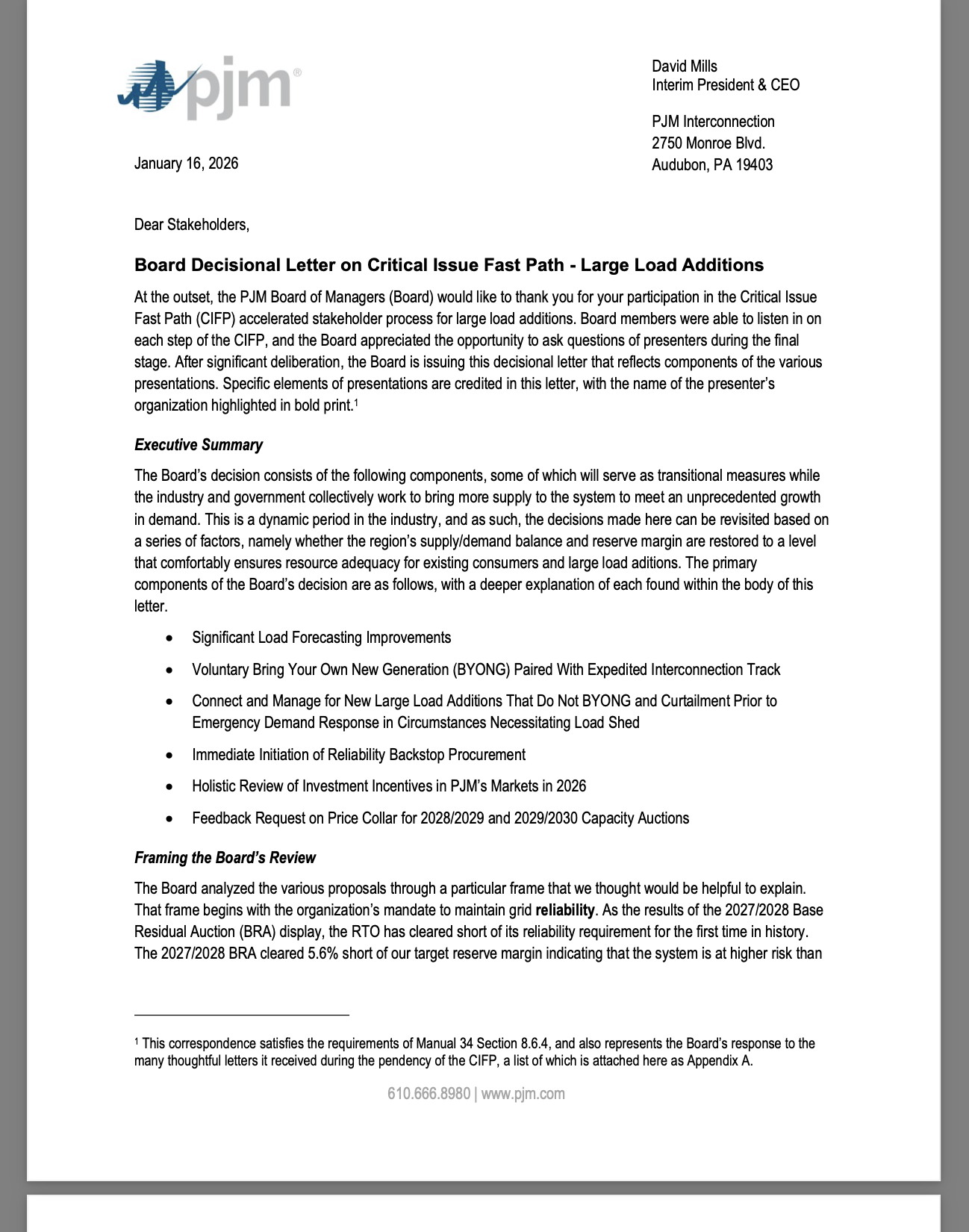
PJM’s new decisional letter on large load additions confirms what recent capacity auction results already showed: market signals alone are not delivering enough new generation to meet rapidly growing demand. For the first time, PJM cleared short of its reliability requirement.
PJM’s new decisional letter on large load additions confirms what recent capacity auction results already showed: market signals alone are not delivering enough new generation to meet rapidly growing demand. For the first time, PJM cleared short of its reliability requirement.
In response, PJM is turning to out-of-market solutions, including reliability backstop procurement, “bring your own generation” options, and expedited interconnection. These steps may be framed as temporary, but they reflect a simple reality: when reliability is at risk, the market isn’t moving fast enough.
This is a challenge largely avoided in regulated markets, where long-term planning and investment certainty support timely generation buildout. That certainty is why regulated states continue to attract data centers and advanced manufacturing that depend on reliable, predictable power.
Read PJM’s full decisional letter here: https://www.pjm.com/-/media/DotCom/about-pjm/who-we-are/public-disclosures/2026/20260116-pjm-board-letter-re-results-of-the-cifp-process-large-load-additions.pdf

Guest Column: Data centers like Meta’s will help lower energy costs
Louisiana is proving that data centers don’t have to mean higher power bills for residents. On the contrary, strategic infrastructure investments tied to industrial growth can be used to improve grid reliability, boost economic growth and lower costs for everyone.

“Louisiana is proving that data centers don’t have to mean higher power bills for residents. On the contrary, strategic infrastructure investments tied to industrial growth can be used to improve grid reliability, boost economic growth and lower costs for everyone.”
At Power for Tomorrow, we track how U.S. utilities adapt to challenges like artificial intelligence and data centers— sharing what works to keep power reliable and affordable. That’s why we’re closely watching the emerging data center hub in the Gulf South, including Louisiana, where Meta is building what may become the world’s largest AI facility in Richland Parish.
Louisiana securing the historic Meta project wasn’t luck — it was leadership. State officials saw the opportunity and worked across party lines to solve a tough problem: how to power massive data centers without raising rates or hurting reliability. Louisiana figured it out — and proved that smart growth can benefit everyone.
U.S. Energy Secretary Chris Wright said, “When people say, ‘AI is going to drive up my price of electricity,’ it’s actually the opposite. The way to get electricity prices down is to produce more electricity.”
The Trump appointee has emphasized that building new infrastructure to support data centers and manufacturing will ultimately lower average electricity prices. In fact, one of the nation’s leading science labs—the same one that Congress selected last year to prepare a report on data center energy usage — recently identified that, in many instances, large customers like data centers can help stabilize or even lower electric bills for homes and small businesses.
In October, The Washington Post published an article titled “There's a reason electricity prices are rising. And it's not data centers,” in which they noted that the recent trend in the national conversation of making data centers the scapegoat for rising electricity prices simply doesn’t hold up when you examine the facts. The article points out that “the biggest factors behind rising rates were the cost of poles, wires and other electrical equipment — as well as the cost of safeguarding that infrastructure against future disasters.”
The article goes on to explain that electricity markets don’t follow the typical economic model where more demand tends to result in higher prices – on the contrary, electrical utilities operate on an economy of scale, where more customers mean more ways to spread out the impact of fixed system costs, like physical infrastructure, and thus, lower costs per customer. Rather than increasing electricity prices, new data center projects present an opportunity to lower prices – if handled the right way.
The key to making new data centers work for existing power customers is to ensure that these giant companies are paying their way and that the cost of their growth isn’t being passed on to other users’ bills. That’s where Louisiana is getting it right: The utility powering Meta’s Richland Parish data center, Entergy Louisiana, and the Louisiana Public Service Commission, built safeguards into Meta’s agreement so other customers don’t foot the bill. In fact, many grid upgrades tied to the project will benefit all customers — at no extra cost.
For example, to meet the data center’s needs without straining the state’s grid, Meta is funding three new Entergy power plants. These modern, more fuel-efficient facilities will serve all Entergy customers and save them money on bills by producing more power at lower cost for decades.
Meta’s investment also provides Entergy with more resources to strengthen the grid against storms at a lower cost to current customers. That means fewer outages and real bill savings, including reducing what other customers pay for grid upgrades and future storm repairs by 10%. All told, Meta’s participation in the Entergy Louisiana grid is projected to save other customers upwards of $650 million over their 15-year agreement.
Louisiana is proving that data centers don’t have to mean higher power bills for residents. On the contrary, strategic infrastructure investments tied to industrial growth can be used to improve grid reliability, boost economic growth and lower costs for everyone.
Gary Meltz is based in New Orleans and is the executive director of Power for Tomorrow.
Clarion Ledger: Mississippi’s proving data centers don’t always mean higher power bills
PFT President Brad Viator writes, in Mississippi’s Clarion Ledger, “Electricity rates are going up nationwide, and data centers aren’t always to blame. But a common misconception by some unfamiliar with how power grids work, is that data centers strain public utilities and raise electricity rates for existing customers.”
PFT President Brad Viator writes, in Mississippi’s Clarion Ledger, “Electricity rates are going up nationwide, and data centers aren’t always to blame. But a common misconception by some unfamiliar with how power grids work, is that data centers strain public utilities and raise electricity rates for existing customers.”
Read the full column here.
Mississippi Monitor: Mississippi’s Proving Data Centers Don’t Always Mean Higher Power Bills
In an article for the Mississippi Monitor, PFT Brad Viator discusses how the historic economic growth happening in Mississippi shows that when utilities take a thoughtful approach to integrating hyperscale customers into public electric grids, new industry like data centers can actually lower—instead of raise—power bills.
In an article for the Mississippi Monitor, PFT Brad Viator discusses how the historic economic growth happening in Mississippi shows that when utilities take a thoughtful approach to integrating hyperscale customers into public electric grids, new industry like data centers can actually lower—instead of raise—power bills.
Read the full article here.

Real Clear Energy : Electric Deregulation Historically Means Higher Power Bills
The millions of Americans who are struggling with under the weight of higher electric bills deserve real relief, not false promises. Weatherizing homes, investing in efficiency, and strengthening the grid can ease some of the costs. But deregulation is a proven failure because it doesn’t lower bills – it raises them. Lawmakers should reject this policy and focus instead on solutions that actually protect customers, not exploit them.
In Real Clear Energy, PFT’s Executive Director writes, “The millions of Americans who are struggling under the weight of higher electric bills deserve real relief, not false promises. Weatherizing homes, investing in efficiency, and strengthening the grid can ease some of the costs. But deregulation is a proven failure because it doesn’t lower bills – it raises them. Lawmakers should reject this policy and focus instead on solutions that actually protect customers, not exploit them.”
Read the full column here.

The Times-Picayune: Electric Deregulation was a Bad Idea in Other Places. And it's Bad for New Orleans
National groups are sniffing around with a risky idea called electric deregulation. It’s being sold as “choice,” but don’t be fooled. Deregulation won’t lower your power bill. It’ll raise it.
Casey DeMoss, a consumer advocate in New Orleans, writes in The Times-Picayune,
“New Orleans has long attracted attention be it good, bad and occasionally glitter-covered. From beignets to brass bands, people can’t seem to stay away from our fair city.
Lately, some of the attention we’re getting isn’t so charming: national groups are sniffing around with a risky idea called electric deregulation. It’s being sold as “choice,” but don’t be fooled. Deregulation won’t lower your power bill. It’ll raise it.
Here’s what’s on the table. Under deregulation, companies called retail suppliers would be allowed to sell you electricity instead of Entergy New Orleans, our regulated utility. That sounds harmless enough until you realize they’ll be selling you the exact same electricity, just at a higher price.”

RTO Insider: PJM Is Flailing, but There’s a Solution
In a recent RTO Insider column, Brad Viator and Alison Williams examine the root causes of PJM’s failures and propose solutions to address its systemic shortcomings.
In a recent RTO Insider column, Brad Viator and Alison Williams examine the root causes of PJM’s failures and propose solutions to address its systemic shortcomings.
“In early July, nine governors, Republicans and Democrats alike, sent a letter to the PJM Board of Managers, whose energy market is responsible for shockingly high rate increases across 13 states and D.C. The governors say that “market participants, consumers and the states” that participate in PJM are having a “crisis in confidence” in the beleaguered grid operator. PJM likely has never been the recipient of such organized, cross-party discontent in its 100-year history. At the heart of the PJM problem is the inability of the grid operator to bring new generation online quickly enough to match skyrocketing demand for electricity.
This shortfall is manifesting directly into exorbitant energy costs. The crisis of timely and affordable generation is largely attributable to a combination of factors: decreased supply because of coal and gas plant retirements, and increased demand because of electrification and data center expansion.”
Read the full column here.

The Hill: Why Utility Deregulation is the Worst Way to Generate More Electricity
Power for Tomorrow expert Ed Hirs, an energy economics professor and UH Energy Fellow at the University of Houston, explains that—despite the rhetoric from deregulation advocates—it’s the traditionally regulated states like Virginia and Georgia that are successfully generating enough electricity to attract and support new data centers.
Power for Tomorrow expert Ed Hirs, an energy economics professor and UH Energy Fellow at the University of Houston, explains that—despite the rhetoric from deregulation advocates—it’s the traditionally regulated states like Virginia and Georgia that are successfully generating enough electricity to attract and support new data centers.
Read his column in The Hill here.

Forbes: Industrial Only Electricity Deregulation Will Be A Disaster For All Louisianans
Power for Tomorrow expert Ed Hirs — a renowned energy economist and lecturer at the University of Houston — published a compelling column that explores the serious risks of “industrial only” electricity deregulation in Louisiana. Hirs makes the case that this policy shift could have wide-reaching consequences for every Louisianan, not just large industrial users.
Power for Tomorrow expert Ed Hirs — a renowned energy economist and lecturer at the University of Houston — published a compelling column that explores the serious risks of “industrial only” electricity deregulation in Louisiana. Hirs makes the case that this policy shift could have wide-reaching consequences for every Louisianan, not just large industrial users.
Read his full column in Forbes here: Industrial Only Electricity Deregulation Will Be A Disaster For All Louisianans

Utility Dive: Surging Data Center Power Demand Risks Subtracting Clean Energy from the Grid
Brad Viator promotes sensible utility regulation with a column in Utility Dive, "Surging data center power demand risks subtracting clean energy from the grid."
Brad Viator’s recent column in Utility Dive promotes sensible utility regulation, “Surging data center power demand risks subtracting clean energy from the grid.”
"Regulators and policymakers must react effectively to big tech’s acquisition of renewable resources by driving investments in new dispatchable energy and capacity…” Brad added:
"Fortunately, there are mechanisms in some parts of the country that can prevent this subtraction without FERC’s intervention. State regulators in traditionally regulated markets have the authority to control electricity supply, and to approve deals like the one AWS and Talen Energy signed. Regulators in Pennsylvania and other wholesale markets should take notice and redevelop the tools they eliminated when they deregulated electricity markets in the last century. This will preserve the ability to advocate for consumers and ensure carbon-free capacity remains available.”