

New Deregulation Advocacy Paper Swings and Misses
It’s been a tough run for supporters of retail utility deregulation. Few states in the last 15 years have shown enthusiasm for adopting the model, and the handful of states that did restructure their utilities in the 1990s and early-2000s have been retreating from it in various ways. It’s not hard to see why. When it comes to electricity, customers care most about reliability, affordability, and consumer protection. Unfortunately, retail deregulation has failed to deliver in these areas.
Against that backdrop, retail deregulation supporters havereleased a new paperthat purports to show the benefits of deregulation. But it is a swing—and a miss.
It’s been a tough run for supporters of retail utility deregulation. Few states in the last 15 years have shown enthusiasm for adopting the model, and the handful of states that did restructure their utilities in the 1990s and early-2000s have been retreating from it in various ways. It’s not hard to see why. When it comes to electricity, customers care most about reliability, affordability, and consumer protection. Unfortunately, retail deregulation has failed to deliver in these areas.
Against that backdrop, retail deregulation supporters have released a new paper that purports to show the benefits of deregulation. But it is a swing—and a miss. The paper, titled, “At the Crossroads: Improving Customer Choice for Products in the U.S. Electricity Sector,” but it might have more accurately been named, “When it Comes to Utility Deregulation, Don’t’ Believe Your Lying Eyes.”
Much of it is a re-hash of the theoretical case for deregulation, but what is most revealing is what the paper does not address. It sweeps under the rug the obvious problems that all but the most ardent deregulation supporters plainly see.
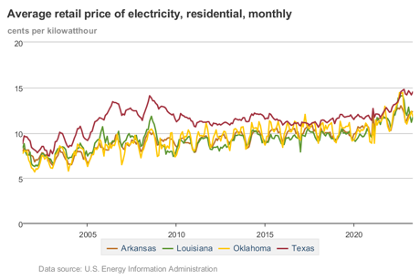
As an initial matter, let’s look at residential retail rates. The paper references several academic studies, and it acknowledges the difficulty in crafting apples-to-apples comparisons across states with various regulatory regimes and resource mixes. That is all well and good – but sometimes a little common sense goes a long way. Just look at average residential electricity rates in Texas, Louisiana, Oklahoma, and Arkansas. Their rates all started in a similar place 20 years ago, and all are contiguous states with a similar resource base. Yet Texas – which is the only one of those states that is overwhelmingly deregulated – has consistently had the highest residential rates for the past two decades. If retail choice worked, wouldn’t there be some point at which the price benefits for customers would be clear?
Another concern, is that the study ignores compelling evidence that retail suppliers charge residential customers much more for power. The study does this by combining residential, commercial and industrial rates into a single number. For an example of why this is misleading, in Massachusetts, the Attorney General recently released a study showing “that in the last six years, individual residential customers who received their electric supply from competitive suppliers paid $525 million more on their electric bills than they would have paid if they stayed with their utility companies.” The study intentionally gives the false impression that residential customers in the Bay State are paying less for power, when, in fact, the opposite is true.
When it comes to reliability, the paper again buries the obvious. Why is it, for example, that the most noteworthy reliability challenges keep happening in states – like Texas and California – that have enacted forms of retail choice and/or utility unbundling? It’s a good question, but not one you’ll hear broached in the paper. It goes so far as to declare that the Texas Winter Storm Uri experience validates the retail competition model. That’s quite a statement considering that experts like Ed Hirs have exhaustively explained why the Texas market structure is actually a root cause of the reliability crises.
Or take for another example, consumer protection. The paper acknowledges a few bad apples engaging in deceptive sales and marketing, but soft pedals the extent of the problem and suggests it can be fixed with better rules and customer education. Yet as Attorneys General and consumer advocates have noted, when it comes to the residential electricity market, consumer protection problems seem to be the feature of electricity retail choice programs, not a bug. In Massachusetts alone, the Attorney General estimates tens of millions of dollars in net consumers losses each year thanks to the residential retail choice scheme.
The challenge for fans of deregulation is that their preferred policies are no longer theoretical prescriptions. We are now dealing with known, comparative policy choices, rather than a referendum on whether traditional utility regulation is perfect. Contrary to the paper’s assertion that we are still learning in “these early years of retail competition,” in truth, we have close to a quarter-century’s worth of experimentation. In that time, the policy hasn’t resulted in lower costs to consumers. It hasn’t provided a more reliable source of power. And it has been a wellspring of consumer protection pitfalls. That’s a track record of failure that will be hard for deregulation’s supporters to overcome when pitching their ideas to lawmakers.

ERCOT Preparedness Tips for NARUC Attendees
Power for Tomorrow wishes all participants in this month’s NARUC Summer Policy Summit an enjoyable visit to Austin. But with ERCOT setting a new demand record of 80,828 MW in June amid 19,000 MW of unplanned firm and renewable outages, and with Texas policy makers yet to address the fundamental flaws in deregulation that have led to the state’s recent electricity woes, we also want to make sure all attendees have the tools they need to stay safe.
Power for Tomorrow wishes all participants in this month’s NARUC Summer Policy Summit an enjoyable visit to Austin. But with ERCOT setting a new demand record of 80,828 MW in June amid 19,000 MW of unplanned firm and renewable outages, and with Texas policy makers yet to address the fundamental flaws in deregulation that have led to the state’s recent electricity woes, we also want to make sure all attendees have the tools they need to stay safe.
When packing for ERCOT, don’t forget the following items:
· A battery-operated fan with a water sprayer, to keep cool while the A/C is off.
· Good walking shoes, in case you are ordered to evacuate and didn’t rent a car.
· Cash, to buy snacks and room-temperature water.
· A radio, preferably one with a hand crank, to receive news and information from emergency management.
· Food. Military-style MREs are great in a pinch.
· Fresh water. Fill the bathtub in your hotel room to barter with for other supplies.
· A battery backup for your cell phone. You won’t have service, but you can take selfies during the evacuation and post them later on Instagram using the hashtag #ERCOT_NARUC2023.
In the event of an ERCOT-induced contingency event, the following information may be helpful.
· Read through Austin’s Get Prepared website, which has tips on how to build your own survival kit.
· Check out Austin’s Emergency Operations Plan, so you know what to expect.
· Monitor ERCOT’s dashboard for up-to-the-minute data. Remember, the supply and demand lines should not cross, and the grid frequency should stay at 60 Hz.
· Keep your car gassed up to avoid long lines after the blackout begins.
· During a blackout, city officials will use libraries as dissemination points for public information. Luckily, the Austin Central Library is only a 12-minute walk west from the JW Marriot.
· If you need to evacuate, the nearest points of safety outside of ERCOT are:
o Nuevo Laredo, Mexico, 3 hours and 45 minutes south on I-35.
o Thackerville, Oklahoma, 4 hours north on I-35.
o Beaumont, Texas, 3 hours and 45 minutes east on TX-71 and I-10.
o El Paso, Texas, 8 hours and 45 minutes west on I-10.
Remember to print this guide and your maps before the internet and cell networks go down. Be safe and enjoy NARUC 2023 in beautiful ERCOT!

In ERCOT, the Buck Stops Nowhere
Two years after Winter Storm Uri caused blackouts and hundreds of deaths across Texas, it is becoming harder to figure out whether anyone will truly be held accountable for the near-collapse of the power grid—and whether anyone will fix the problems before the next crisis.
Two years after Winter Storm Uri caused blackouts and hundreds of deaths across Texas, it is becoming harder to figure out whether anyone will truly be held accountable for the near-collapse of the power grid—and whether anyone will fix the problems before the next crisis.
Earlier this month, the Texas Supreme Court ruled that ERCOT cannot be sued. The court held that because ERCOT is an arm of state government, the doctrine of “sovereign immunity”—originally conjured up by English courts to protect the King—prevents Texans from bringing ERCOT to court for money damages or injuries from the market’s failures during Storm Uri. Even the relatives of Texans who died due to the mismanagement of the grid have no remedy against ERCOT in court.
Outside of Texas, ratepayers in the multistate markets are at least able to sue their RTO/ISOs, which are structured as nonprofits. However, those markets have a different sovereignty problem: the states have surrendered part of their traditional powers over electric utilities by putting the market regulators in charge of the grid. State legislatures have no power over RTO/ISO decision making, so voters have no input into how these markets are run. Moreover, the market operators lack authority to require the states to build transmission and generation. This creates a collective action problem, where one state may refuse to build resources that primarily benefit another. It also creates an accountability problem, with no single regulator or utility having to bear the full weight of responsibility for keeping the lights on. This can be seen in PJM and MISO, where events during Winter Storm Elliot are being studied by the markets, various state commissions, and FERC, each of which has only part of the authority needed to solve the problems.
Ratepayers deserve a straightforward answer to the question of who is responsible for ensuring there are adequate resources to ensure they have reliable power. But under industry restructuring and today’s market constructs, this is no longer possible. ERCOT’s victory in court is a stark example of this disconnect, with the grid operator asserting a royal power to avoid direct accountability for grid issues that affect ERCOT’s ratepayer subjects. While Texans wait for answers about how to avoid the next Storm Uri, and consumers across the Midwest and Southeast wonder whether next winter will bring another Storm Elliot, they should ask whether they can safely rely on the RTO/ISO status quo of grid operation without representation.

The Chaos Continues in PJM
For years, energy policy wonks have asked when RTOs will expand. Perhaps just as pertinent a question at this point is, “why would a state willingly subject itself to this chaos?”
As noted in this blog several weeks ago, the nation’s largest RTO is fighting multiple fires simultaneously. From changes in its rules, to battles with the states, to growing reliability risks – PJM has its hands full.
And we now know the fate of one the proposals at FERC that arose from this confluence of troubles. Late last week, FERC narrowly approved PJM’s plan to delay its capacity auction. But judging by the order’s attached Commissioners’ statements, PJM should take little solace from its preferred result.
In dissent, Commissioner Allison Clements described the matter as a “recipe for chaos.” She has a point, though it could fairly be said that the current state of PJM is less a recipe, and more a fully baked cake of chaos. Commissioner James Danly said as much. He voted for the order delaying the auction, but because he believes PJM’s rules are already so “manifestly unjust and unreasonable” that delaying the auction was an appropriate action by FERC.
For states already in PJM, it must be a frustrating experience. Having ceded a good deal of responsibility for electricity delivery to the RTO, they now find their state policy goals and their consumers at the mercy of a large bureaucracy that, as acknowledged by its own federal regulators, is teetering towards chaos.
For states that are not in the RTO, the lessons of this experience are important. Amidst the disorder in PJM, supporters of the expansion of RTOs have been busy whitewashing the record. No where has this been more evident than in South Carolina, where consultants that do work for PJM, unsurprisingly, extolled the virtues of PJM to state legislators, while downplaying or ignoring obvious problems.
Yet, as John Adams wrote, “facts are stubborn things,” and it is a hard to see how policymakers in any non-RTO state will look at these facts as flattering towards RTO membership. For years, energy policy wonks have asked when RTOs will expand. Perhaps just as pertinent a question at this point is, “why would a state willingly subject itself to this chaos?”

Massachusetts Electricity Policy in the Spotlight
If you’re looking for a well-researched report that puts a human face on many of the pitfalls of electricity deregulation, you’d do well to review the recent series from Miriam Wasser of WBUR, the NPR station in Boston. It highlights several major concerns such as customer cost, consumer protection and a lack of transparency by marketers regarding the power they are selling.
If you’re looking for a well-researched report that puts a human face on many of the pitfalls of electricity deregulation, you’d do well to review the recent series from Miriam Wasser of WBUR, the NPR station in Boston. It highlights several major concerns such as customer cost, consumer protection and a lack of transparency by marketers regarding the power they are selling.
The WBUR report sums up the cost problem succinctly:
“Massachusetts is one of about a dozen states where residents can choose to buy electricity from a supplier other than their default utility. When lawmakers set up this system in the late 1990s, the assumption was that a competitive marketplace would result in lower power prices for customers. But for the most part, the opposite has happened.”
It goes on to note that the burden of this policy has fallen especially hard on those who can least afford it such as the poor, the elderly, and non-native English speakers. How bad is it? The report notes the Massachusetts Attorney General’s office could not find “a single case of a company that has been able to charge customers less than a utility over a multi-year period.”
Part 2 of the report discusses why those “100 percent renewable” plans marketed by energy middlemen, may, in fact, be less green than consumers believe. It is a cautionary tale, which should remind consumers that things aren’t always as advertised.
None of this will come as a surprise to those that follow electricity policy debates. These reports arrive on the heels others from The Wall Street Journal, The New York Times, and The Baltimore Sun, which explored similar themes.
WBUR offers another piece of information in the series. It is a list of recommendations on how to avoid paying too much and being scammed by competitive electricity marketers. It’s sound advice for anyone living in the roughly dozen states that restructured their retail electricity supply. There should be one more tip to added to the list, however. A good first recommendation would be: encourage your public policymakers to maintain sensible, traditional regulation of your state’s utility providers.

Electric Reliability Under Congressional Scrutiny
Too often, debates about wholesale “markets” are driven by superficial discussions about competition being preferable to regulation. Of course, that is true, but how do we compare an increasingly dysfunctional “competition” construct to generally functioning and well-understood regulation of an essential public service?
Members of Congress are taking notice of electric reliability woes, especially in the nation’s RTOs. In a letter to FERC, leadership of the powerful U.S. House Energy and Commerce Committee asked several pointed questions of the agency related to reliability and the performance of RTOs. Specifically, Committee leadership asked:
In your view, are the current Regional Transmission Organizations (RTO) or Independent System Operators (ISO) the best mechanism to provide reliable electricity? Please explain.
Do current market rules allow dispatchable, on-demand generation resources the opportunity to recover sufficient revenues to continue to operate in the RTOs/ISOs? If so, which rules? If not, would you recommend FERC direct RTOs/ISOs to implement such rules?
How do RTOs/ISOs compare to traditionally regulated regions in terms of electric reliability? Please provide specific data.
What policies, whether federal, state, or market rules, prevent sufficient resource adequacy in RTOs/ISOs necessary to power the grid 24/7/365 regardless of the weather?
Gas power generators are not required to procure firm gas transportation in RTO/ISO markets. How will the Commission ensure that market design adequately compensates natural gas generators for the reliability benefits of firm natural gas transportation?
The questions are a good starting point for Congress to embark on a deep dive into what is ailing the grid. Blackouts in California and Texas, and near-misses in other RTO regions, should spur thoughtful inquiries into what is going wrong. This Congressional letter does just that, including specific references to challenges in CAISO, MISO, SPP and PJM.
The inquiry will also be a good datapoint for state policymakers that are endeavoring to learn more about how different market and regulatory structures best serve their constituents. Too often, debates about wholesale “markets” are driven by superficial discussions about competition being preferable to regulation. Of course, that is true, but how do we compare an increasingly dysfunctional “competition” construct to generally functioning and well-understood regulation of an essential public service? That’s a more appropriate discussion because it more closely mirrors what is happening in electricity policy today. It’s good to see Congressional leaders asking the right questions so an honest dialogue can be had.

RMR is Just a Shorthand for Market Failure
Among the alphabet soup of acronyms known by RTO-watchers is one that is cropping up with increased frequency: the RMR (or for the uninitiated, the “reliability-must-run” contract). These cost-of-service based contracts are last-ditch measures that throw lifelines to plants needed for reliability, but that would otherwise close based on the revenues they derive from the market. Practically, the result of RMRs is that generation units are insulated from the outcomes of markets and paid instead based on their cost to operate.
Among the alphabet soup of acronyms known by RTO-watchers is one that is cropping up with increased frequency: the RMR (or for the uninitiated, the “reliability-must-run” contract). These cost-of-service based contracts are last-ditch measures that throw lifelines to plants needed for reliability, but that would otherwise close based on the revenues they derive from the market. Practically, the result of RMRs is that generation units are insulated from the outcomes of markets and paid instead based on their cost to operate.
Last week’s FERC procedural order related to an RMR for longtime deregulation booster, NRG, is a reminder these RMRs won’t be going away any time soon (Docket No. ER22-1539-001). To be fair, no player in this industry, not even market purist NRG, is likely to renounce an RMR if it is available. Nor should RTOs hold to “markets” at the expense of reliability and keeping the grid operational.
But the proliferation of RMR contracts in the nation’s RTOs could prompt a reexamination of those markets, which apparently cannot operate without the crutch of cost-of-service contracts for vital units that support reliability. For instance, a threshold question might be: shouldn’t a functioning market maintain an operational grid without cost-of-service interventions? If a ‘market’ cannot be sustained except by central planners intervening and rewarding crucial units with out-of-market contracts, then how much of a market is it in the first place? Finally, if central planners (RTOs/ISOs) have to intervene again and again with cost-of-service based contracts to keep the construct viable, perhaps the market itself is the failure?

Pandemonium in PJM
The list of challenges within PJM is growing, and quick fixes are not readily apparent. PJM, FERC and the states will need to avoid the missteps that have imperiled other RTOs, as in Texas and California, where the threat of blackouts and volatile prices are a year-round concern.
It has been a rough few months in PJM. Multiple wildfires are burning in the nation’s largest RTO, and it isn’t obvious when they’ll subside. Four matters in particular bear watching in the months ahead.
Capacity Auction Chaos
It’s no secret that PJM’s capacity markets have been challenged in recent years, and little suggests that will soon change. Seeing prices that PJM deemed were too high in one recent auction, the RTO proposed, and FERC approved, a plan to re-write auction rules midstream. That drew the ire of merchant generators that now stand to lose significant revenues. Litigation ensured. More recently, PJM recognized its auction rules are broken, and it has now proposed delaying auctions while it attempts yet another fix.
Winter Storm Elliott and its Fallout
PJM narrowly avoided major blackouts during the Christmas 2022 cold snap associated with Winter Storm Elliott. Over 20 percent of the generators in PJM failed to produce as expected. The failure has resulted in assessments of between $1 and $2 billion in penalties against non-performing generators. That has led to further chaos, with generators either seeking to avoid their penalties or by obtaining relief through outright bankruptcy. Apparently worried about how this might affect reliability. FERC itself approved a pathway for generators to continue producing power, even if they are in default.
Growing Tension with States
PJM and the states have a frequently uneasy relationship. That is no secret. Policy makers have a keen interest in PJM matters because the RTO makes decisions that impact consumers and the generation mixes within states. An emerging trend is for states to seek greater transparency into the secretive stakeholder processes that drive much of PJMs decision making. Officials in two states, West Virginia and Maryland, are pursing such a course, and the outcome of their efforts may encourage even more states to press PJM for reforms.
Reliability Storm Clouds Gathering
Finally, PJM leadership has flagged the retirement of generation as an additional concern. Reports indicate a looming capacity crisis, as demand is soon projected to outstrip generation availability.
The list of challenges within PJM is growing, and quick fixes are not readily apparent. PJM, FERC and the states will need to avoid the missteps that have imperiled other RTOs, as in Texas and California, where the threat of blackouts and volatile prices are a year-round concern. As the nation’s largest RTO, encompassing states with varying regulatory structures, PJM serves as a bellwether and cautionary tale for problems that are bedeviling ISOs and RTOs generally. It is safe to assume the next few years will be busy for the consulting firms, NGOs, associations, and stakeholders that drive the RTO. It is less clear how well this will all turn out for consumers.

Where the Rubber Meets the Road: Utility Regulation and EVs
In addition to the sizable increase in generation capacity that would be required to energize a large fleet of EVs, the wires portion of the utility business would need to invest billions to accommodate changing power demands and dynamics.
This week’s announcement that the Biden Administration’s EPA will pursue new car rules that would lead to a major expansion of electric vehicles is a reminder of the important role state and federal regulators will play in any rapid electrification of the transportation sector. The new strict pollution limits would result in EVs comprising more than half of cars sold in 2030. Considering that the AP reports that less than 10 percent of vehicles sold today are electric, it is a dramatic increase in a short amount of time.
If U.S. auto sales reach even a fraction of that growth it is going to mean a lot of work for the nation’s utilities and the regulators who oversee them. In addition to the sizable increase in generation capacity that would be required to energize a large fleet of EVs, the wires portion of the utility business would need to invest billions to accommodate changing power demands and dynamics. Even before the EPA announcement, some experts were projecting that every EV on the road would necessitate between $1,700 and $5,800 in grid upgrades. Take that figure times tens of millions of vehicles, and you begin to get an idea of the size of the investment that will be required.
And who will be making decisions about a sizeable portion of those dollars? Utility regulators at the federal, and (especially) state level of government, that’s who. Many of the needed grid upgrades will be in the wires portion of the electricity business, which is to say the regulated part, even in places that have unbundled and deregulated other portions, such as generation. There is no getting around it, utility company capital expenditures and their ability to recover those investments will make or break electrification of the vehicle fleet. That means regulators and utilities will need to sharpen their pencils and do the work of protecting the public interest. Sending proper investment signals, limiting cross-subsidization, ensuring timely rate recovery, and considering alternative ratemaking methodologies should all be on the table.
The issue bears some similarity to implementation of last year’s “Inflation Reduction Act.” In that legislation, billions of dollars were directed to renewable generation investments, but little changed in terms of the infrastructure needed to accommodate it – especially electric transmission. Though still early, the implications of that approach are coming into focus: vast sums of money for renewables are effectively sidelined because left unresolved is the nuts-and-bolts of utility regulation, like permitting, interconnection, and cost recovery of electric transmission. Infrastructure becomes the chokepoint in deploying renewables.
EV’s could face a similar fate, with a lack of infrastructure stymieing their deployment, unless policymakers and regulators can get ahead of the curve. That starts with establishing smart regulatory policies that provide both customers and utilities with the clarity needed to facilitate transportation electrification.

When Hyperbole Becomes Delusion
Any casual observer of politics knows that hyperbole is a frequent, if unwelcome, occurrence in public policy advocacy. Sometimes, however, an exaggeration is so wild that it drifts into delusion. Such is the case with a collection of electric deregulation’s biggest boosters called the Texas Competitive Power Advocates (TCPA).
Any casual observer of politics knows that hyperbole is a frequent, if unwelcome, occurrence in public policy advocacy. Sometimes, however, an exaggeration is so wild that it drifts into delusion. Such is the case with a collection of electric deregulation’s biggest boosters called the Texas Competitive Power Advocates (TCPA).
At issue is Texas legislation that proposes to build a fleet of electric generation facilities as an insurance policy against the obvious reliability problems in the Texas electricity market. Whatever one thinks of the legislative proposal, the TCPA response to it is instructive. The group commented that, “Texas’ competitive electric market has been the envy of electricity markets around the world, but these bills would scuttle that prized market.”
Two issues in particular stand out in the TCPA statement.
First, calling Texas a “competitive” market is a misnomer. Rather, it is dominated by just a few unrestrained energy oligopolies that deliver power at prices above what a competitive market would permit. If regulation is a second-best option to competition, then Texas has the worst of all worlds. It is competition in name only, with no regulatory backstop to protect consumers who are subject to a non-competitive market.
Second, TCPA proves itself delusional when it claims the Texas market structure is the envy of the world. Call us skeptical that there are many citizens around the globe longing to adopt this so-called “prize” that delivers unreliable power at volatile rates. We now have several years’ worth catastrophes and near-misses in Texas, and it isn’t confined to any one season. Nearly any weather (hot, cold, or mild) now seems to trigger emergency operations for a grid that is chronically on the brink of failure.
It is understandable the oligopolies in the TCPA would seek to protect their fiefdom. What company willing forfeits a line of business that is subject neither to effective competition nor regulatory oversight? Nonetheless, they might garner more than just eye rolls if they would at least finally acknowledge what the rest of the world accepts at face value: Texas-style electricity deregulation is deeply flawed, and it isn’t something other jurisdictions will be adopting any time soon.

Deregulated Energy Oligopolies Bristle at Bad Press
Supporters of the deregulated utility model like to portray themselves as plucky pro-consumer white knights, in contrast to traditionally regulated utilities. Turns out, the deregulated oligopolies are more than capable of securing the sort of anti-competitive, anti-consumer sweetheart deals that they accuse other companies of seeking.
As this blog has noted before, the electricity markets in deregulated utility states trend towards oligopolies with unrestrained market power, rather than pro-consumer competition. More evidence of this fact came to light this week in filings before the Texas PUC.
As reported by Bloomberg, Texas regulators revealed that according to the ERCOT Independent Market Monitor, “[t]he ability for certain suppliers of grid services ‘to effectively control the price’ caused the price of those reserves ‘to exceed competitive levels,’ tacking on between $285 million to $380 million over the course of the year, according to a filing.”
Catch that? In the aftermath of Winter Storm Uri, large retail energy oligopolists have engaged in a pattern of behavior in which they control prices in the Texas market, which resulted in consumers paying in a single year more than a quarter billion dollars above what a competitive market would yield.
In case you’re wondering if you’ll soon see Enron-style perp walks on your TV, you need not hold your breath. In terse statements released by the deregulated utility oligopolies, they bristled at the suggestion they’ve done anything wrong. Take for example, NRG, whose spokesperson said, “NRG has not been accused of market power abuse by the PUC, nor is NRG under investigation for market abuse.” It is a clever way of dodging the real issue.
What the Texas PUC is saying happened is a near textbook definition of an exercise of anti-competitive market power. But the oligopolists can claim they aren’t under investigation for it, or for breaking any laws or rules because, as Bloomberg explains, the companies operated under Commission approved contracts that gave “them an ‘absolute defense’ [against] any allegations of market manipulation.” Those contracts have now been partially changed going forward, but not before a lot of economic damage was done.
In the case of NRG, Texas regulators, on their own, partially terminated the “absolute defense” provision, since, according to the filing, NRG was, “not interested in negotiating a modification.” And why would it be? As Mel Brooks’ Louis XVI said in A History of the World Part I, “It’s good to be the King.” And that is what Texas’ leading deregulated utility oligopolies have become in Texas: kings of the hill. As noted by Bloomberg, a small cadre of merchant generators wield enormous influence in ERCOT.
It’s ironic, because supporters of the deregulated utility model like to portray themselves as plucky pro-consumer white knights, in contrast to traditionally regulated utilities. Turns out, the deregulated oligopolies are more than capable of securing the sort of anti-competitive, anti-consumer sweetheart deals that they accuse other companies of seeking.

Consumer Groups Know Deregulation Is Not About the Consumer
Deregulation is sold in a variety of ways to the public, but it keeps coming up short in practice. To be sure, there are those who benefit – the competitive suppliers, the big customers, particularly from the tech industry –but the regular consumer has seen no benefit, and much confusion.
In recent comments to the Louisiana Public Service Commission on retail energy “competition,” AARP Louisiana summed up the track record of deregulated electric states:
“Not only have the promised benefits of lower electricity rates and better service not materialized in states that have deregulated but, importantly reliability of the grid has been put at risk. “
Other than not saving customers’ money, not improving serving and degrading grid reliability, electric deregulation has been a rip-roaring success. Ask Texas as it is stuck with a single retail electric provider with nearly 75 percent market share and a shaky grid still trying to recover from the catastrophe of winter storm Uri.
Meanwhile, consumer groups including The National Consumer Law Center, Public Citizen, the Maryland Energy Advocates Coalition, and the Pennsylvania Utility Law Project commented to the Federal Trade Commission on the FTC’s Green Guides, which seek to inform retail customers about energy marketers claims about their products. The consumer groups call out energy marketers for abusing the easily-abusable Renewable Energy Credit (RECs) to “greenwash” their energy products to consumers. In reality, the marketers are buying fossil-based products, tacking on a REC, and charging a premium to unsuspecting customers.
Deregulation is sold in a variety of ways to the public, but it keeps coming up short in practice. To be sure, there are those who benefit – the competitive suppliers, the big customers, particularly from the tech industry –but the regular consumer has seen no benefit, and much confusion.

Illness and RTOs: What’s the Prognosis?
The latest developments in PJM are symptomatic of a broader issue that has been in plain sight for some time now: the RTO/ISO model, and particularly the strain of the capacity market model, is not only dysfunctional—it is outright failing.
Commissioner Danly offered the following observation in a fiery dissent issued this week in response to a FERC order approving a post-bidding change to the PJM capacity auction:
There is significant evidence — particularly increasing reliability risk throughout the country — that the FERC-jurisdictional power markets are sick and dying, and it is the Commission’s fault.
The willingness to take responsibility is refreshing. But it seems that Commissioner Danly is being too hard on himself. The latest developments in PJM are symptomatic of a broader issue that has been in plain sight for some time now: the RTO/ISO model, and particularly the strain of the capacity market model, is not only dysfunctional—it is outright failing.
The folks in the room where it happens, i.e., the intrepid reporters at RTO Insider summarized the outcome as follows:
FERC late Tuesday approved PJM’s request to revise the reliability requirement for the DPL South zone to avoid an artificial fourfold increase in capacity prices for delivery year 2024/25, rejecting complaints that it was changing its rules retroactively (ER23-729).
PJM asked for authority to exclude planned generation capacity resources from the calculation of a locational deliverability area’s reliability requirement if the addition of such resources increases the requirement by more than 1% and the resources do not enter a sell offer into the auction.
The commission ruled that PJM’s proposal will ensure competitive outcomes that conform to the actual reliability needs and fundamentals of supply and demand.
OK – what? Basically, here is how your normal human would see what has happened. PJM held a competitive solicitation. PJM got the results. PJM did not like the results. So PJM changed the rules.
Imagine if an investor-owned utility did this in an integrated resource planning process—all hell would break loose, with allegations of anti-competitive and self-serving behavior abounding. Yet in the RTOs/ISOs, while there are objections and there will be potentially successful litigation against FERC to follow, it is the new normal: a “market” yields a result that you don’t like? Retroactively change the outcome to a result you deem more congenial.
The post hoc solutions and constantly moving parameters are now hallmarks of the shadow, “non-profit” administrative state that are RTOs/ISOs. Indeed, with this latest step, even the greatest restructuring enthusiasts—NRG, Vistra, EPSA to name a few—are up in arms over the outcome.
Commissioner Danly’s dissent drew a Las Vegas parallel:
The house saves a bit of money on one hand, but no one ever plays blackjack at the Federal Energy Regulatory Casino again. That is this case. The only difference is that the capacity market is not a game but rather the mechanism by which we ensure sufficient generation resources are built and maintained to keep the lights on.
The casino reference is a good one. And perhaps the way the movie Casino ends, with the casinos on the strip reduced to rubble, is the path the current RTO/ISO model is on.
More States Questioning Broken Electricity “Markets”
It may be weeks until spring in much of the U.S., but ideas for fixing broken electricity markets are beginning to bud across the country. And while you wouldn’t know it if you only read current events through a Washington, DC lens, it has long been true that the frontlines of energy policy are in the states. With legislatures now in full swing throughout the country, it’s a good time to highlight some of the more interesting matters taking shape in the states.
It may be weeks until spring in much of the U.S., but ideas for fixing broken electricity markets are beginning to bud across the country. And while you wouldn’t know it if you only read current events through a Washington, D.C. lens, it has long been true that the frontlines of energy policy are in the states. With legislatures now in full swing throughout the country, it’s a good time to highlight some of the more interesting matters taking shape in the states.
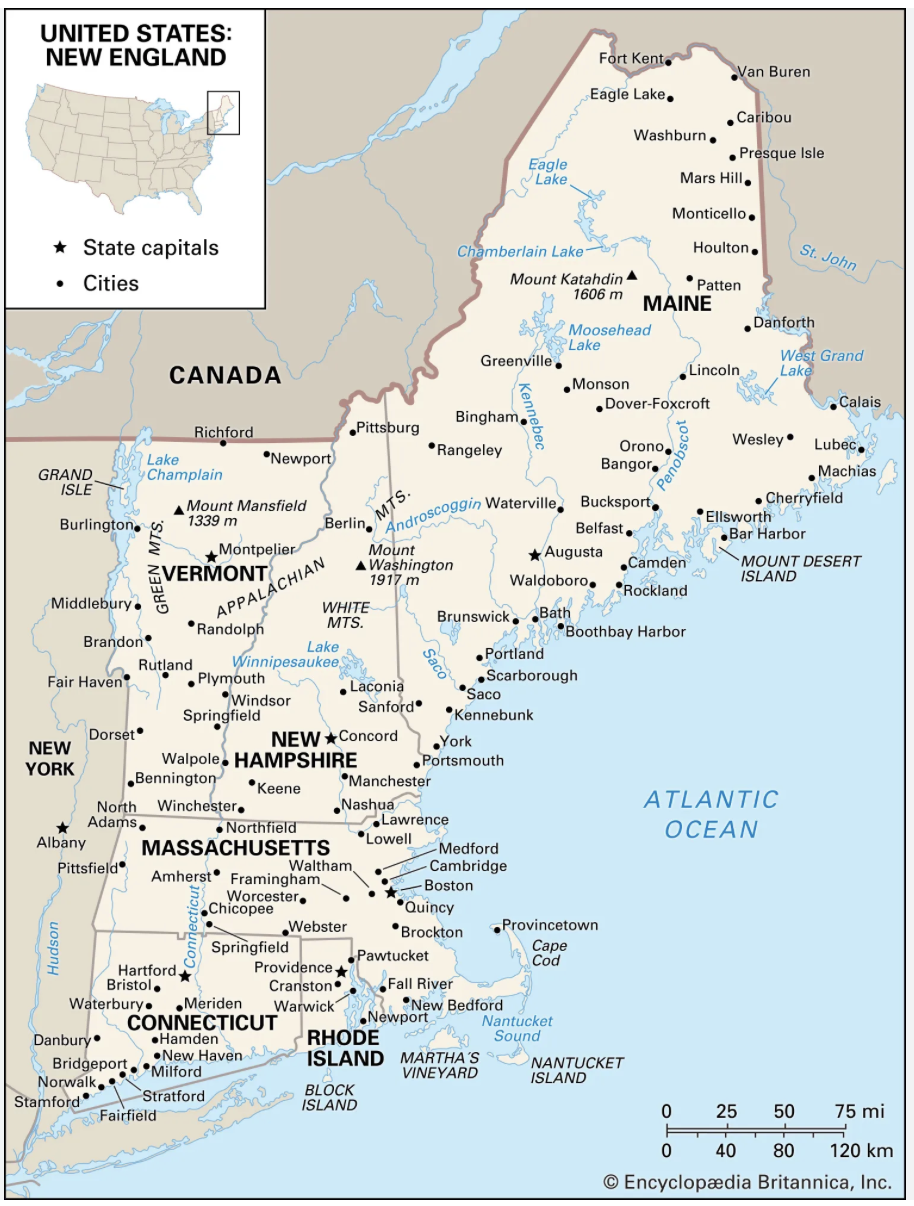
New England is a region particularly worth watching. It has typically had some of the nation’s highest priced energy, and this winter the costs have been worse than most. In turn, it is spurring significant debates in the states about how to help consumers.
In Connecticut, legislators are asking tough questions about large rate hikes that recently went into effect. They are learning that it is not the state regulated utilities that are the reason for the increases. It is wholesale costs, driven by spiking natural gas prices, out-of-state generators, and broken markets, as explained in this report from Connecticut Public Radio.
Just up the road in Massachusetts, newly elected Governor Maura Healey has long been a supporter of reforming the state’s unfortunate experiment with electricity restructuring. In her former job as the Commonwealth’s Attorney General, she conducted extensive oversight of the state’s energy sector and supported ending retail deregulation for residential customers. By her estimates, residential customers lost over $400 million dollars through so-called “competitive” energy supply contracts. As the state’s new top elected official, she’ll be in a position to enact the changes she has long championed.
And over in New Hampshire, legislators have begun asking questions about whether the state would be better off untethering from ISO-New England, the region’s Regional Transmission Organization. HB 443 calls for a study of leaving the RTO and follows similar inquires in past years in Maine and Connecticut. The legislation had its first hearing at the end of January and remains pending.
Moving out of New England, and as noted by this blog several days ago, Nevada’s new Governor called for a fundamental re-evaluation of the danger of the state being drawn too tightly into dysfunctional electricity “markets.” Gov. Joe Lombardo’s State of the State was an important reminder that reliability and affordability are among the most important issues for his state – or for any state.
These are but a few examples of state leaders asking questions about how to structure utility regulation for the benefit of customers. What may be most noteworthy is the bi-partisan nature of the calls for reform. It all points to the fact that energy policy is not a red or blue issue. Reliability and affordability are issues that leaders of all political stripes are able to embrace. If you want to see that in practice, it pays to keep three words in mind: watch the states.

Back to Basics
As January turns to February, there is still time for one last New Year’s Resolution, so let’s start by offering a resolution to FERC Chairman Phillips: Emphasize the need for FERC to get back to basics.
As January turns to February, there is still time for one last New Year’s Resolution, so let’s start by offering a resolution to FERC Chairman Phillips: Emphasize the need for FERC to get back to basics.
Activists and enthusiasts – particularly those hailing from Capitol Hill – cannot resist the prospect of turning administrative agencies into vehicles for realizing their policy ends. This is a widespread lament. When Congress is paralyzed, or better yet, prefers to abdicate its policymaking prerogatives to agencies, the agencies become the place where the policymaking action happens.
Turn to the tenure of FERC Chairman Glick, whose ambitions to transform, cajole and force the utility industry toward his preferred policy visions had few constraints. You could blame his background coming from Capitol Hill, where such unconstrained policymaking is supposed to happen; or you could blame an energy policy climate that is frenetic in its urgency and righteousness.
Enter Chairman Phillips, who comes from the DC Public Service Commission. State (and District) utility regulators tend to come from institutional backgrounds that are more modest and focused on the actual utility customer. By focusing on the actual customer, you get a regulatory outlook that focuses on the basics: affordability, reliable service, balancing the interests of providers and customers.
FERC has a tradition of focusing on such goals. Indeed, until the activists started performatively disrupting FERC meetings, FERC had a bi-partisan consensus as a law-abiding agency that stuck to keeping energy plentiful, reliable and affordable. Let’s get back to basic at FERC.
Three Cheers for Nevada's Governor Lombardo
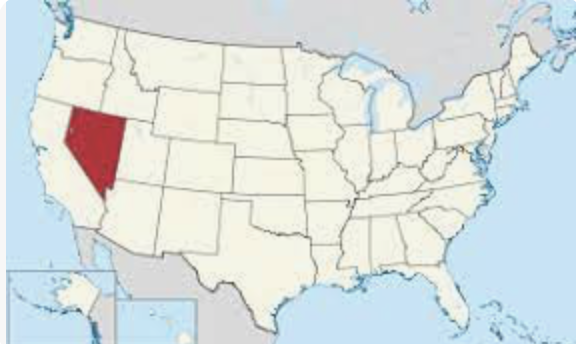
The new year is a time for resolutions, both attainable and unattainable. In the state regulatory space, however, particularly in a time of rapid transition and challenging markets economics, it is important to develop a resolution with a clear and focused goal. For state regulators, regardless of political stripe or policy bent, the recent State of the State by new Nevada Governor Joe Lombardo is worthy of review and reflection.
The new year is a time for resolutions, both attainable and unattainable. In the state regulatory space, however, particularly in a time of rapid transition and challenging markets economics, it is important to develop a resolution with a clear and focused goal. For state regulators, regardless of political stripe or policy bent, the recent State of the State by new Nevada Governor Joe Lombardo is worthy of review and reflection:
I call your attention to another area of challenge and opportunity: energy. California does not have enough electric generation within its own state to meet its electricity needs – and is now relying on the broader western electric market to import energy.
With California retiring its units and changing its transmission rules, we have no choice but to reduce our reliance on the market and seek energy independence for all Nevadans.
To address this, I will issue an executive order that allows electric providers, to develop dedicated in-state generation resources, to ensure that we are no longer forced to rely on the broader electric market.
Our energy independence will spur economic development, lead to job creation, and drive lower-cost energy for all Nevadans.
This discussion—a fairly nuanced one as energy and regulatory policy in a State of the State goes—is sure to elicit incoming fire from RTO enthusiasts and left-leaning policy wonks. But there are some important takeaways in the speech worth considering for state regulators as 2023 ramps up and gets rolling.
Resource adequacy is imperative and the number one priority as numerous energy providers simultaneously transition their generation fleets. States should manage their resources to ensure customer needs are met. That requires a clear-eyed assessment of the resource adequacy situation in your state and out of your state, much like Governor Lombardo did in his speech. This assessment informs steps that may need to be taken, including politically unpopular ones, to ensure needs are met. Yes, that might include gas-fired generation. Gas generation is one of the unsung heroes of the clean energy transition, and we cannot forget that perhaps inconvenient truth as we move forward.
In addition, state regulators should resolve to balance affordability and utility financial health. Healthy companies can facilitate the transition in the most cost-effective way, but price volatility can lead to an impulse to penalize or punish regulated entities in rate cases and other cases involving cost recovery. Regulators should use available tools to stabilize rates, not near-term hammers to reduce or mitigate them because they can affect the health of the providers and the ability to continue on the long path toward a cleaner future for the power sector.
Governor Lombardo’s speech implicitly recognizes this dynamic, and while the concept of “energy independence” may be of concern in certain quarters, it addresses resource adequacy issues, creates certainty for customers, and provides investment opportunities for regulated entities. This trifecta can and should form the basis for New Years Resolutions for state regulators across the country.
The New York Times Calls the Bluff on the Deregulation Cabal
The new year arrived with some bad press for the small but vocal group of electricity deregulation advocates that continues to peddle its preferred policy prescriptions. It came in the form of a New York Times article highlighting the failure of electricity deregulation to deliver on its promises of lower energy costs for consumers.
The new year arrived with some bad press for the small but vocal group of electricity deregulation advocates that continues to peddle its preferred policy prescriptions. It came in the form of a New York Times article highlighting the failure of electricity deregulation to deliver on its promises of lower energy costs for consumers.
While Energy Twitter gadflies made a parlor game out of pointing out misused acronyms and nomenclature in the story, that misses the forest for the trees. The salient takeaway was that the Times found it was traditional, state-centric utility regulation that continues to deliver the best value for consumers. In its own words, “Average retail electricity costs in the 35 states that have partly or entirely broken apart the generation, transmission and retail distribution of energy into separate businesses have risen faster than rates in the 15 states that have not deregulated, including Florida and Oregon. That difference has persisted for much of the last two decades or so, including in the last year, when energy prices increased worldwide after Russia invaded Ukraine. On average, residents living in a deregulated market pay $40 more per month for electricity than those in the states that let individual utilities control most or all parts of the grid. Deregulated areas have had higher prices as far back as 1998.”
The article notes that the primary drivers for these differences arise from at least two factors: (1) wholesale market design in which all suppliers – regardless of their own costs – get paid what the most expensive units needed for reliability require for compensation to run; and (2) the increasing cost of transmission being passed on to consumers.
Put another way, it is all about design incentives. Deregulation, as defined by the Times, creates individual products that are piece-parts (generation, transmission, distribution) of the system that provides a usable product – electricity – to consumers. In practice, this can result in an outcome in which the different products (like generation and transmission) each individually maximize profits, with limited consideration for what that means for the rate paid by average customers who receive a bill each month. In contrast, when a utility is traditionally regulated – as in the 15 states the Times noted have lower overall costs – it must go before a state regulatory commission to prove the way it is handling investments, as a whole, provide reasonably priced service to its customers. In the utility industry, this is known as “bundled” service. When a regulator reviews this bundled rate, it is seeking to ensure that generation, transmission and distribution are planned cohesively and work together to provide a reasonably priced product to the end-use customer.
As with any complicated topic, a mainstream press article is likely to raise at least as many questions as it answers, and this one is no different. The article lumps all states that have joined RTOs as having been “deregulated,” a point the crew on Twitter seized on to try and point out lack of understanding. But further analysis could seek to explore the distinctions between the states that have fully deregulated, and those that have maintained some aspects of vertical integration while existing within an entity like an RTO/ISO. It might also attempt to better quantify how much more consumers have been paying for generation given the unique nature of how the organized markets price energy. It would be illuminating to know the extent of any windfall profits that generators may have earned from these wholesale market design choices. Analyzing reliability data amongst different regulatory regimes might prove enlightening also. It’s all worthy of more discussion and debate, but this much is clear: 2023 has arrived and the deregulation cabal is on notice. The press is watching, and they are awakening to the fact that the promises of deregulation are being weighed against the failures of its results.
New Year's Resolutions Part 1
Over the next several weeks, this blog will propose New Year’s Resolutions for those in and around the electricity policy arena. We will start with one that should always be first in the minds of anyone with responsibility for oversight of the electric grid: shore up reliability and resource adequacy.
Over the next several weeks, this blog will propose New Year’s Resolutions for those in and around the electricity policy arena. We will start with one that should always be first in the minds of anyone with responsibility for oversight of the electric grid: shore up reliability and resource adequacy.
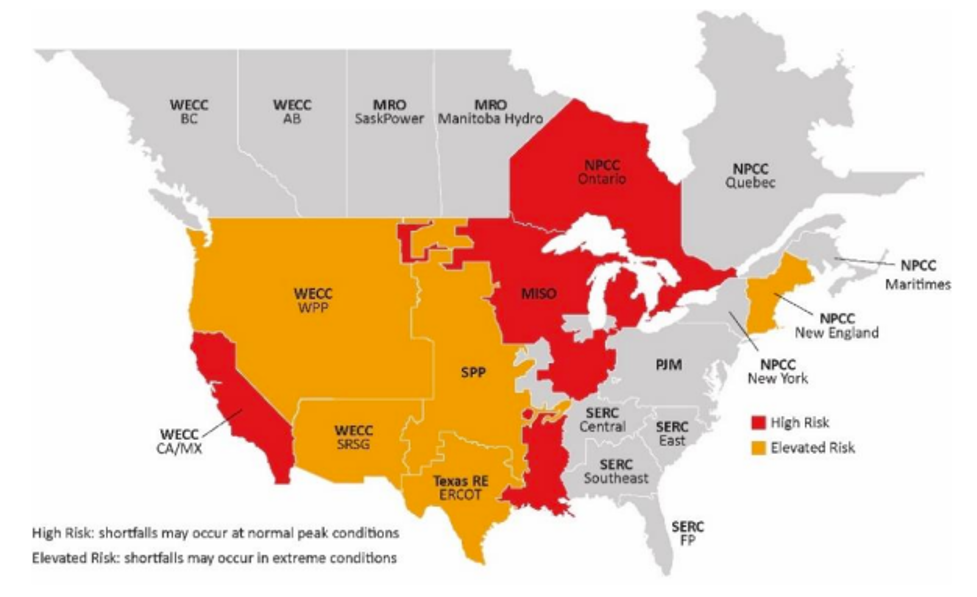
It’s a timely topic, because it is clear this isn’t your parents’ electricity grid. While blackouts and reliability challenges have always been a reality, threats to grid reliability have increased in frequency and criticality. While some of this is outside the control of any one entity – for example, the challenges posed by technological changes in how electricity is produced, or extreme weather – other matters are squarely in the purview of those charged with making decisions about the institutions in which energy providers operate. And on this score, there is more than enough evidence to suggest there are problems. As shown on this map released by the North American Reliability Corporation last month, reliability risks are real, and they are not limited to a small footprint.

The challenges vary by region, but at least two takeaways should inform discussions. In regions covered by RTOs, especially those where the RTO is charged with operating a market that ensures resource adequacy, more must be done to fix failing market designs that are not maintaining and building a fleet of resources that can provide 24/7 reliability. While California and Texas are two prime examples of the failure of flawed deregulation schemes, it should be acknowledged that merely the presence of traditional state-led regulation (such as in large parts of the West) does not alone ensure resource adequacy. In these regions, states must take a proactive role in ensuring their utilities can provide for reliability, and this starts with a realistic assessment of the availability of capacity to deliver energy on demand throughout the region. These realistic assessments then form the basis of the plans that can deliver the power consumers expect. Thus, it is with some encouragement that consumers should view developments such as the Western Resource Adequacy Program, which is attempting to do just this very thing.
The sobering thing about New Year’s Resolutions is that for most, they only last a few weeks before falling back into old habits. Let’s hope that a focus on reliability and resource adequacy is one that has staying power year-round.
Deregulated Texas Gets a Bad Report Card from NERC
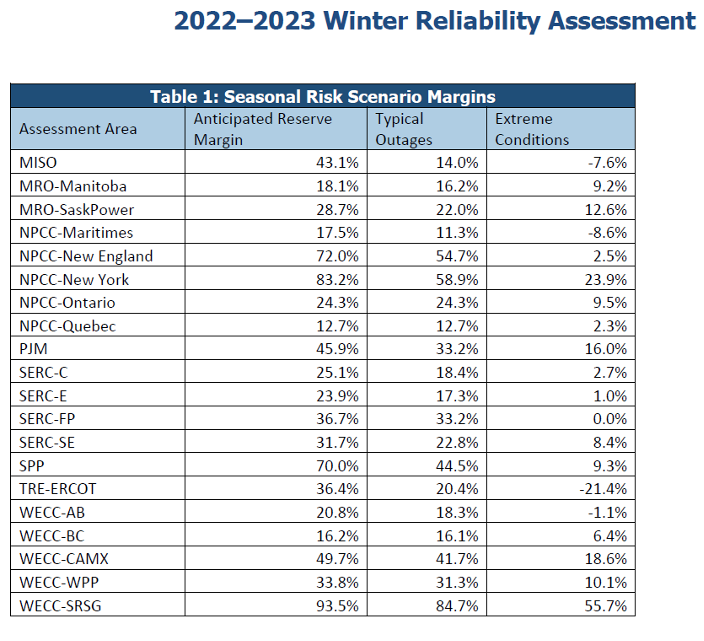
Last month, the North American Electric Reliability Corporation (NERC) released its 2022-2023 Winter Reliability Assessment, and it should serve as a wake-up call for those still arguing that the deregulated electricity model is a beacon for the nation to follow.
The fact is, it is a failed experiment, and one no other state should adopt.
The North American Electric Reliability Corporation (NERC) released its 2022-2023 Winter Reliability Assessment, and it should serve as a wake-up call for those still arguing that the deregulated electricity model is a beacon for the nation to follow.
Unlike parts of the country where the electricity grid is regulated with reliability in mind, the model Texas has employed for the last 20-plus years does not have incentives to keep and build dispatchable generation resources. It is thus chronically at risk of extreme system conditions swamping available supply.
The results of this policy choice are increasingly clear. The table below from page 8 of the NERC report shows just how perilous the situation is in Texas. Under extreme conditions – just the sort of scenarios that are happening with greater frequency – Texas will run a capacity deficit of negative 21.4 percent. That is multiples worse than any other region of the country. It’s something to keep in mind when special interests or misguided policymakers start pushing deregulation as a policy prescription. The fact is, it is a failed experiment, and one no other state should adopt.

Energy Inflation, Deregulation, and the Laboratories of Democracy
The anti-consumer effects of deregulation become more evident every day as the energy inflation crisis continues. It should serve as a wake-up call for those willing to study the outcomes being produced in our nation’s state policy incubators.
United States Supreme Court Associate Justice Louis Brandeis’ famous observation that states serve as the “laboratories of democracy,” is a useful framework for policymakers considering the effects of utility restructuring and deregulation. Not every state has made the same choice in electricity policy, and because of that, we have variables against which we can test hypotheses and measure the impacts of utility regulatory policy.
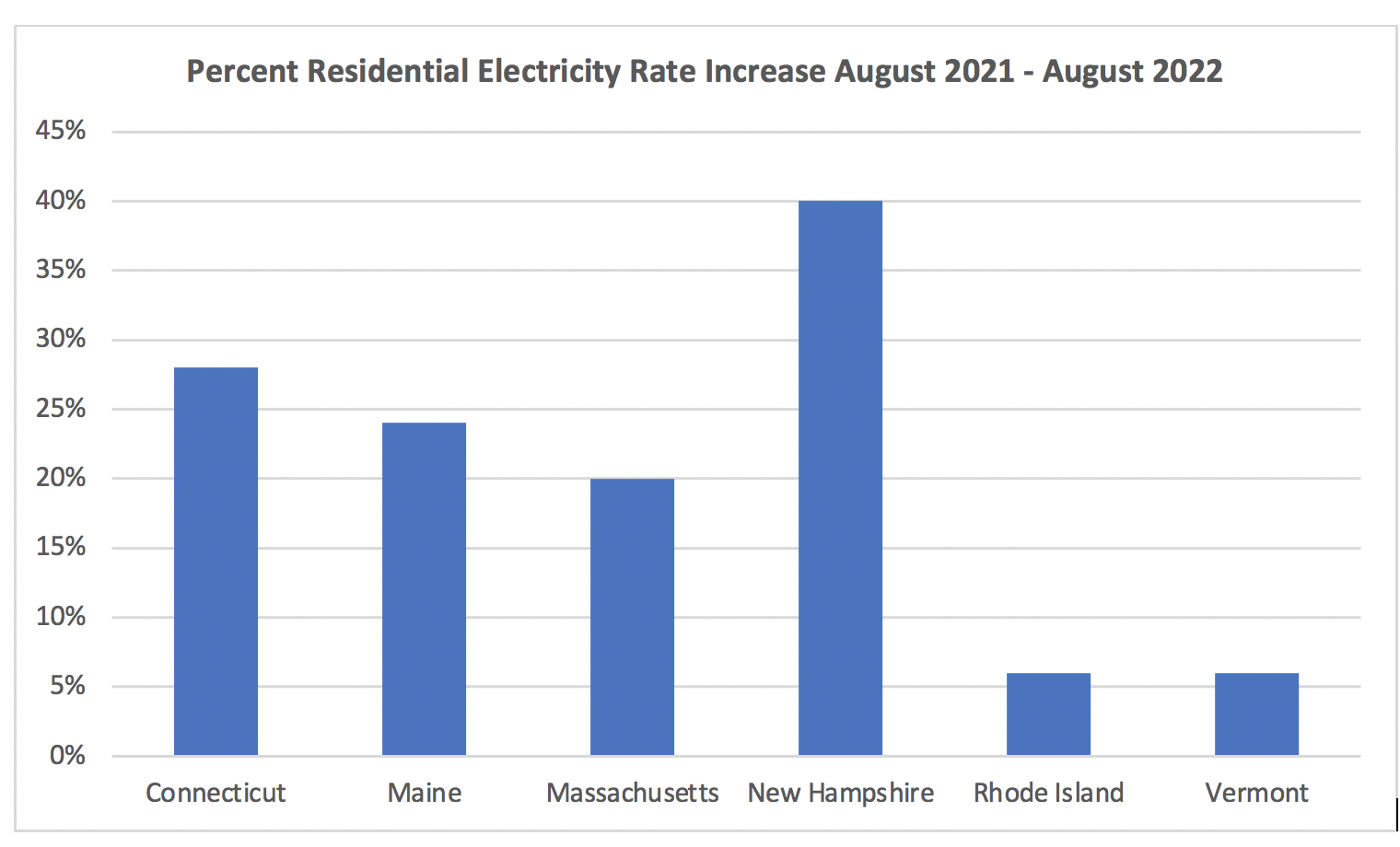
As previously noted by this blog, one particularly intriguing laboratory is New England. Five of the six New England states fully deregulated, while Vermont alone still engages in traditional utility regulation. One hypothesis is that when wholesale and energy commodity market prices spike, consumers in deregulated states (being more directly exposed to market pricing) will see electricity rates climb higher and faster than in traditionally regulated states (where customers are protected with longer-term supply contracts that support a more diverse generation resource portfolio).
Sure enough, the hypothesis is being confirmed in real time. Look at the latest monthly data available from the Energy Information Administration related to residential retail electricity rates in New England:

Every New England state, save Rhode Island, has seen significantly higher electricity rate hikes than regulated Vermont. But even the Rhode Island anomaly can be explained. Ocean State residents will soon be in the same boat as their deregulated New England brethren. The default electricity rate in Rhode Island was set to rise 47% beginning October 1, and is not yet captured in the EIA data, but it is only a matter of time before the results of the test are complete. The anti-consumer effects of deregulation become more evident every day as the energy inflation crisis continues. It should serve as a wake-up call for those willing to study the outcomes being produced in our nation’s state policy incubators.