Gary Meltz Gary Meltz

Pricing Data Confirms Families Pay More in Deregulated Electricity States

For years, proponents of electricity deregulation have argued that competition lowers costs for consumers. New data tells a very different story.

According to new proprietary analysis by Power for Tomorrow (PFT), informed by 2024 Energy Information Administration (EIA) data, residential customers in deregulated electricity states are paying dramatically more for power than those in traditionally regulated markets. 

For years, proponents of electricity deregulation have argued that competition lowers costs for consumers. New data tells a very different story.

According to new proprietary analysis by Power for Tomorrow (PFT), informed by 2024 Energy Information Administration (EIA) data, residential customers in deregulated electricity states are paying dramatically more for power than those in traditionally regulated markets. 

Read the full analysis here.

The Price Gap Is Significant and Growing

Across the lower 48 states, the contrast is stark:

  • Average residential price in deregulated states: 21.80 cents per kWh

  • Average residential price in regulated states: 14.18 cents per kWh

That means:

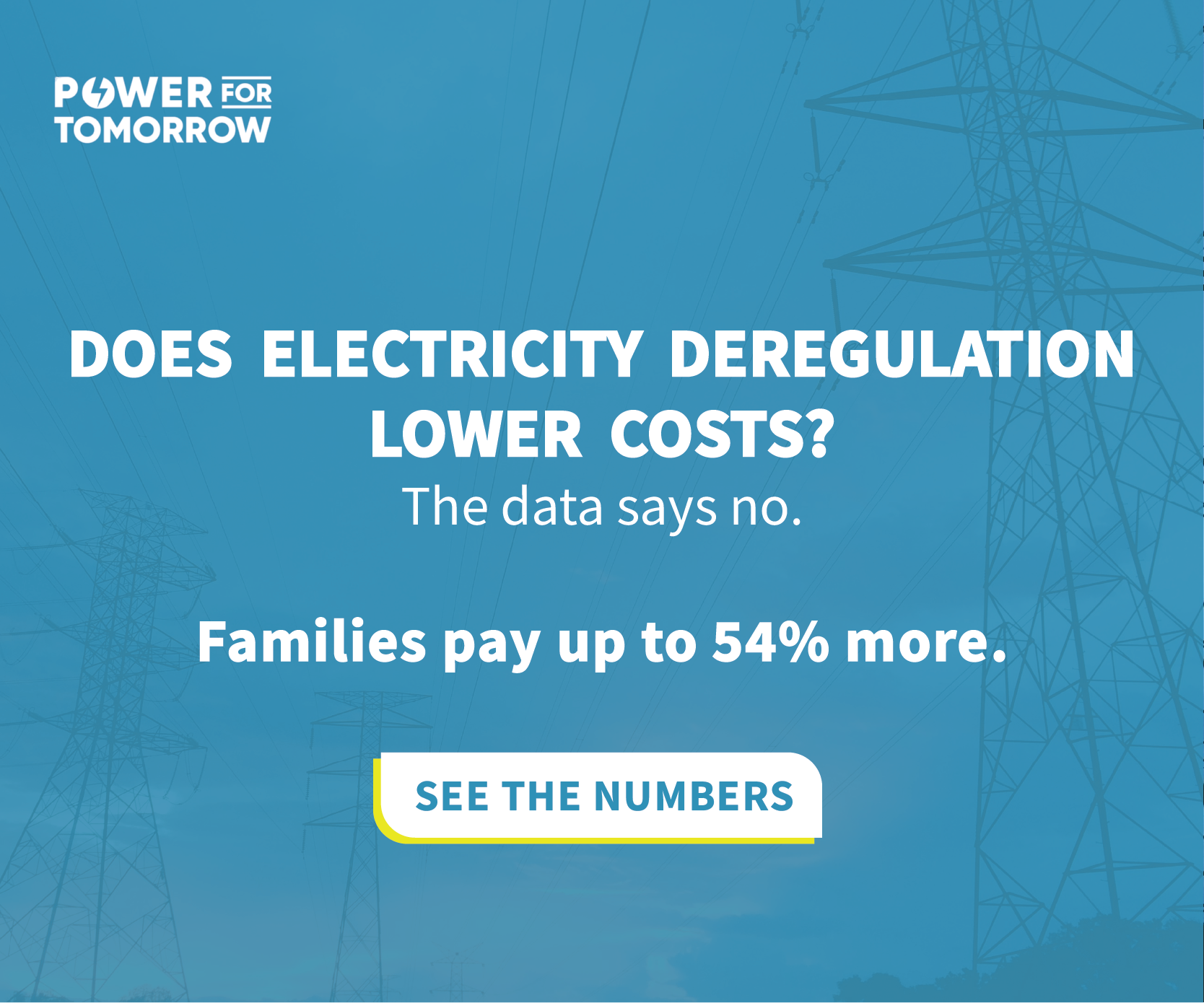
  • U.S. households in deregulated states pay 42% more on average

  • In the lower 48 states, the difference jumps to 54% more

This is not a marginal difference—it is a structural cost burden that directly affects household budgets, especially for low- and middle-income families.

Deregulation Dominates the Highest-Cost States

The distribution of prices further underscores the trend.

  • 7 of the 10 highest-priced states (including Washington, D.C.) are deregulated

  • 8 of the 10 highest-priced states in the lower 48 are deregulated

  • 11 of the top 15 highest-priced states are deregulated

By contrast, the lowest-cost states tell a completely different story:

  • All 15 of the lowest-priced states are fully regulated

In other words, if you want affordable residential electricity, regulated markets overwhelmingly outperform deregulated ones. 

What This Means for Energy Policy

These findings raise serious questions about continued efforts to push deregulation as a one-size-fits-all solution. While competition may work in theory, electricity is not a typical consumer good. Power systems require long-term planning, infrastructure investment, reliability standards, and regulatory oversight—especially as demand grows from electrification, data centers, and advanced manufacturing.

Regulated markets provide:

  • Price stability

  • Long-term system planning

  • Consumer protections

  • Clear accountability

Deregulated markets, by contrast, often expose customers to price volatility, market speculation, and fragmented oversight—costs that ultimately show up on monthly bills.

The Bottom Line

The data is clear: electricity deregulation has not delivered lower prices for residential consumers. In fact, families in deregulated states are paying substantially more—often without seeing commensurate benefits in reliability or service.

As policymakers consider reforms to meet future energy demand, affordability must remain central. This analysis demonstrates that smart regulation—not deregulation—has been the most reliable path to lower residential electricity costs.

Read More
Gary Meltz Gary Meltz

Poll: Louisiana Voters Reject Electricity Deregulation Once They Learn the Facts

A recent poll of Louisiana voters, conducted by Peak Insights, reveals a striking trend: while many initially support electricity deregulation, that support collapses once they learn what it actually means.

A recent poll of Louisiana voters, conducted by Peak Insights, reveals a striking trend: while many initially support electricity deregulation, that support collapses once they learn what it actually means.

At first glance, 61% of voters expressed support for deregulation, believing it would introduce competition and lower prices. However, after learning about the real-world consequences—such as higher costs, reduced oversight, and reliability concerns—opposition surged to 78%, with only 14% still in favor.

Here’s why voters overwhelmingly reject deregulation:

  • Loss of Local Control – Voters want Louisiana’s Public Service Commission (PSC) to regulate electric rates, not out-of-state corporations.

  • Higher Prices – In states that have deregulated, electricity costs have soared, with some customers paying double.

  • Less Reliable Service – Deregulation weakens oversight, increasing the risk of outages, particularly during extreme weather.

Voters also rejected so-called “partial” or “industrial” deregulation, which would allow large corporations to bypass the regulated system. Opposition to this proposal jumped from 55% to 81% when voters learned it could lead to higher costs for households and a less stable power grid.

The takeaway is clear: the more Louisianans learn about deregulation, the more they oppose it.

Read More
Gary Meltz Gary Meltz

Harvard Business School: Do Markets Reduce Prices? Evidence from the U.S. Electricity Sector

Compared to utilities in states that stayed regulated, deregulated utilities faced significantly higher costs of energy. This resulted from both higher wholesale prices as well as purchasing a higher share of energy, instead of generating it. We find that restructuring lead to sharp increases in wholesale prices despite reductions in marginal fuel costs, such that generation facilities were able to charge prices at substantial margins above costs. We show that this can explain a large portion of the increase in retail rates after the restructuring of the electricity sector.

Read the full report.

“Compared to utilities in states that stayed regulated, deregulated utilities faced significantly higher costs of energy. This resulted from both higher wholesale prices as well as purchasing a higher share of energy, instead of generating it. We find that restructuring lead to sharp increases in wholesale prices despite reductions in marginal fuel costs, such that generation facilities were able to charge prices at substantial margins above costs. We show that this can explain a large portion of the increase in retail rates after the restructuring of the electricity sector. “

Read the full report.

Read More
Chris Chris

The Vertically Integrated Utility: A Time-Tested Approach for Delivering Customer Benefits and Ensuring State Flexibility in Achieving Energy Policy Goals.

In this white paper, the WBK team (Tony Clark, Ray Gifford, and Matt Larson) makes the case that a vertically integrated utility (VIU) model provides a tried and true pathway to implement state policy directives and achieve outcomes in the best interests of customers.  The political allure of utility restructuring is understandable. It caters to the interests of both libertarian-minded “free market” advocates and those on the left who may be suspicious of VIUs serving a captive customer base. But for present-day leaders of states that have not restructured, it is worth understanding the foundation of the VIU and its comparative advantages amidst ongoing energy policy debates.

In this white paper, the WBK team (Tony Clark, Ray Gifford, and Matt Larson) makes the case that a vertically integrated utility (VIU) model provides a tried and true pathway to implement state policy directives and achieve outcomes in the best interests of customers.  The political allure of utility restructuring is understandable. It caters to the interests of both libertarian-minded “free market” advocates and those on the left who may be suspicious of VIUs serving a captive customer base. But for present-day leaders of states that have not restructured, it is worth understanding the foundation of the VIU and its comparative advantages amidst ongoing energy policy debates.

Read More