
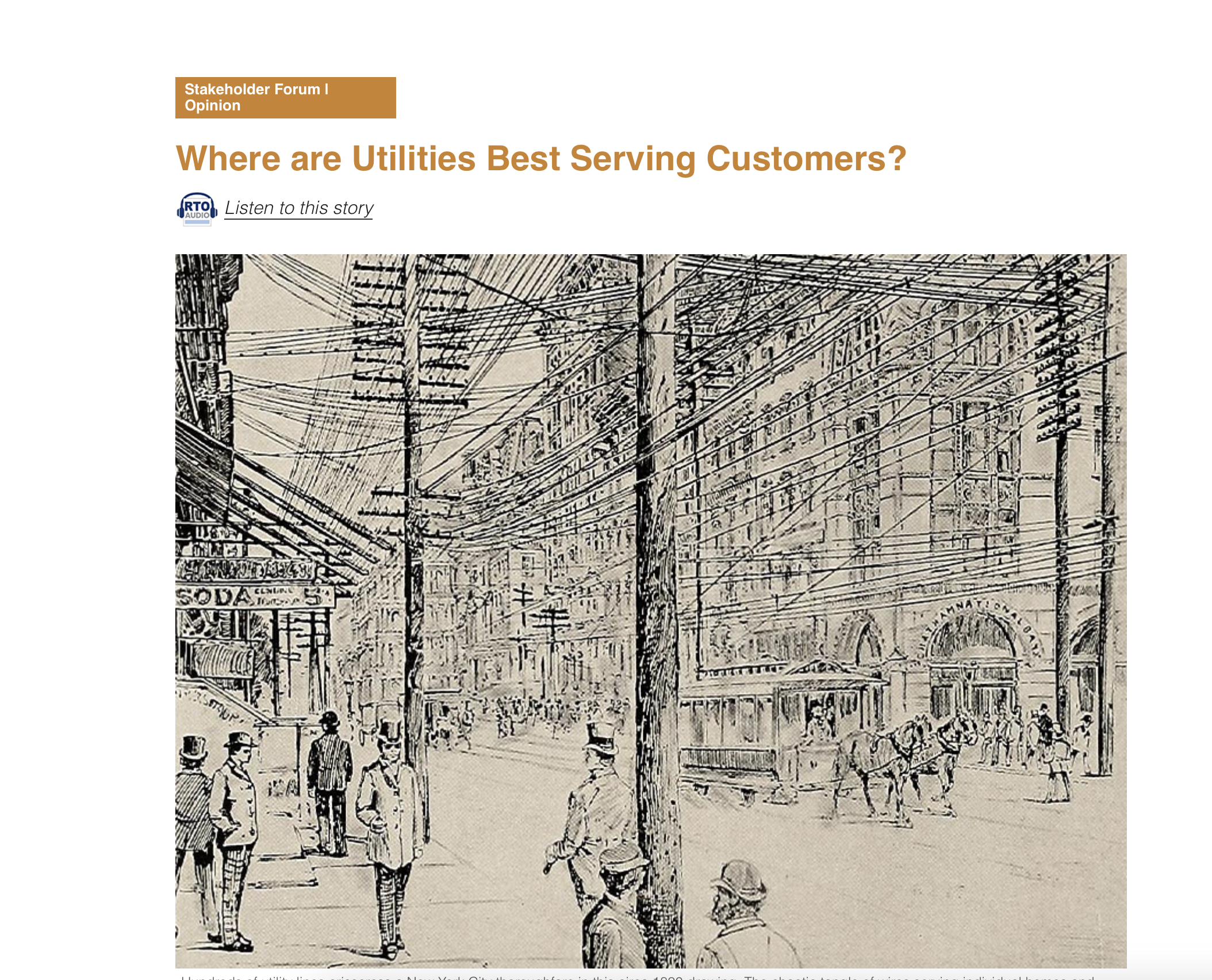
RTO Insider: Where are Utilities Best Serving Customers?
As PJM grapples with reliability, load growth, and market failures, policymakers are still debating what might work next. Meanwhile, one model has already been delivering real results for more than a century.
Alison Williams of Power for Tomorrow makes the case that well-regulated, vertically integrated utilities are doing exactly what today’s power system needs.
As PJM grapples with reliability, load growth, and market failures, policymakers are still debating what might work next. Meanwhile, one model has already been delivering real results for more than a century.
Alison Williams of Power for Tomorrow makes the case that well-regulated, vertically integrated utilities are doing exactly what today’s power system needs:
Shielding customers from price spikes
Supporting economic growth and industrial competitiveness
Delivering reliability through long-term planning and accountability
The data are hard to ignore: residential customers in deregulated states paid 42% more for electricity than those served by vertically integrated utilities, and the gap is growing.
At a moment when energy policy conversations are accelerating fast, this article asks a simple question policymakers should keep front and center:
What actually works for customers?
Read the full article here.
Guest Column: Data centers like Meta’s will help lower energy costs
Louisiana is proving that data centers don’t have to mean higher power bills for residents. On the contrary, strategic infrastructure investments tied to industrial growth can be used to improve grid reliability, boost economic growth and lower costs for everyone.
“Louisiana is proving that data centers don’t have to mean higher power bills for residents. On the contrary, strategic infrastructure investments tied to industrial growth can be used to improve grid reliability, boost economic growth and lower costs for everyone.”
At Power for Tomorrow, we track how U.S. utilities adapt to challenges like artificial intelligence and data centers— sharing what works to keep power reliable and affordable. That’s why we’re closely watching the emerging data center hub in the Gulf South, including Louisiana, where Meta is building what may become the world’s largest AI facility in Richland Parish.
Louisiana securing the historic Meta project wasn’t luck — it was leadership. State officials saw the opportunity and worked across party lines to solve a tough problem: how to power massive data centers without raising rates or hurting reliability. Louisiana figured it out — and proved that smart growth can benefit everyone.
U.S. Energy Secretary Chris Wright said, “When people say, ‘AI is going to drive up my price of electricity,’ it’s actually the opposite. The way to get electricity prices down is to produce more electricity.”
The Trump appointee has emphasized that building new infrastructure to support data centers and manufacturing will ultimately lower average electricity prices. In fact, one of the nation’s leading science labs—the same one that Congress selected last year to prepare a report on data center energy usage — recently identified that, in many instances, large customers like data centers can help stabilize or even lower electric bills for homes and small businesses.
In October, The Washington Post published an article titled “There's a reason electricity prices are rising. And it's not data centers,” in which they noted that the recent trend in the national conversation of making data centers the scapegoat for rising electricity prices simply doesn’t hold up when you examine the facts. The article points out that “the biggest factors behind rising rates were the cost of poles, wires and other electrical equipment — as well as the cost of safeguarding that infrastructure against future disasters.”
The article goes on to explain that electricity markets don’t follow the typical economic model where more demand tends to result in higher prices – on the contrary, electrical utilities operate on an economy of scale, where more customers mean more ways to spread out the impact of fixed system costs, like physical infrastructure, and thus, lower costs per customer. Rather than increasing electricity prices, new data center projects present an opportunity to lower prices – if handled the right way.
The key to making new data centers work for existing power customers is to ensure that these giant companies are paying their way and that the cost of their growth isn’t being passed on to other users’ bills. That’s where Louisiana is getting it right: The utility powering Meta’s Richland Parish data center, Entergy Louisiana, and the Louisiana Public Service Commission, built safeguards into Meta’s agreement so other customers don’t foot the bill. In fact, many grid upgrades tied to the project will benefit all customers — at no extra cost.
For example, to meet the data center’s needs without straining the state’s grid, Meta is funding three new Entergy power plants. These modern, more fuel-efficient facilities will serve all Entergy customers and save them money on bills by producing more power at lower cost for decades.
Meta’s investment also provides Entergy with more resources to strengthen the grid against storms at a lower cost to current customers. That means fewer outages and real bill savings, including reducing what other customers pay for grid upgrades and future storm repairs by 10%. All told, Meta’s participation in the Entergy Louisiana grid is projected to save other customers upwards of $650 million over their 15-year agreement.
Louisiana is proving that data centers don’t have to mean higher power bills for residents. On the contrary, strategic infrastructure investments tied to industrial growth can be used to improve grid reliability, boost economic growth and lower costs for everyone.
Gary Meltz is based in New Orleans and is the executive director of Power for Tomorrow.

Real Clear Energy : Electric Deregulation Historically Means Higher Power Bills
The millions of Americans who are struggling with under the weight of higher electric bills deserve real relief, not false promises. Weatherizing homes, investing in efficiency, and strengthening the grid can ease some of the costs. But deregulation is a proven failure because it doesn’t lower bills – it raises them. Lawmakers should reject this policy and focus instead on solutions that actually protect customers, not exploit them.
In Real Clear Energy, PFT’s Executive Director writes, “The millions of Americans who are struggling under the weight of higher electric bills deserve real relief, not false promises. Weatherizing homes, investing in efficiency, and strengthening the grid can ease some of the costs. But deregulation is a proven failure because it doesn’t lower bills – it raises them. Lawmakers should reject this policy and focus instead on solutions that actually protect customers, not exploit them.”
Read the full column here.

The Times-Picayune: Electric Deregulation was a Bad Idea in Other Places. And it's Bad for New Orleans
National groups are sniffing around with a risky idea called electric deregulation. It’s being sold as “choice,” but don’t be fooled. Deregulation won’t lower your power bill. It’ll raise it.
Casey DeMoss, a consumer advocate in New Orleans, writes in The Times-Picayune,
“New Orleans has long attracted attention be it good, bad and occasionally glitter-covered. From beignets to brass bands, people can’t seem to stay away from our fair city.
Lately, some of the attention we’re getting isn’t so charming: national groups are sniffing around with a risky idea called electric deregulation. It’s being sold as “choice,” but don’t be fooled. Deregulation won’t lower your power bill. It’ll raise it.
Here’s what’s on the table. Under deregulation, companies called retail suppliers would be allowed to sell you electricity instead of Entergy New Orleans, our regulated utility. That sounds harmless enough until you realize they’ll be selling you the exact same electricity, just at a higher price.”

The Hill: Why Utility Deregulation is the Worst Way to Generate More Electricity
Power for Tomorrow expert Ed Hirs, an energy economics professor and UH Energy Fellow at the University of Houston, explains that—despite the rhetoric from deregulation advocates—it’s the traditionally regulated states like Virginia and Georgia that are successfully generating enough electricity to attract and support new data centers.
Power for Tomorrow expert Ed Hirs, an energy economics professor and UH Energy Fellow at the University of Houston, explains that—despite the rhetoric from deregulation advocates—it’s the traditionally regulated states like Virginia and Georgia that are successfully generating enough electricity to attract and support new data centers.
Read his column in The Hill here.

Forbes: Industrial Only Electricity Deregulation Will Be A Disaster For All Louisianans
Power for Tomorrow expert Ed Hirs — a renowned energy economist and lecturer at the University of Houston — published a compelling column that explores the serious risks of “industrial only” electricity deregulation in Louisiana. Hirs makes the case that this policy shift could have wide-reaching consequences for every Louisianan, not just large industrial users.
Power for Tomorrow expert Ed Hirs — a renowned energy economist and lecturer at the University of Houston — published a compelling column that explores the serious risks of “industrial only” electricity deregulation in Louisiana. Hirs makes the case that this policy shift could have wide-reaching consequences for every Louisianan, not just large industrial users.
Read his full column in Forbes here: Industrial Only Electricity Deregulation Will Be A Disaster For All Louisianans